


09 Sep How Nike Lost Its Stride
Posted at 17:35h
in INSIGHTS
At its pinnacle, Nike’s brand was second to none in the apparel sector, transforming sportswear from a functional product into a symbol of performance and status. To think of Nike was to think of Michael Jordan, Tiger Woods, or Serena Williams – the world’s greatest athletes serving as living proof of the brand’s promise.
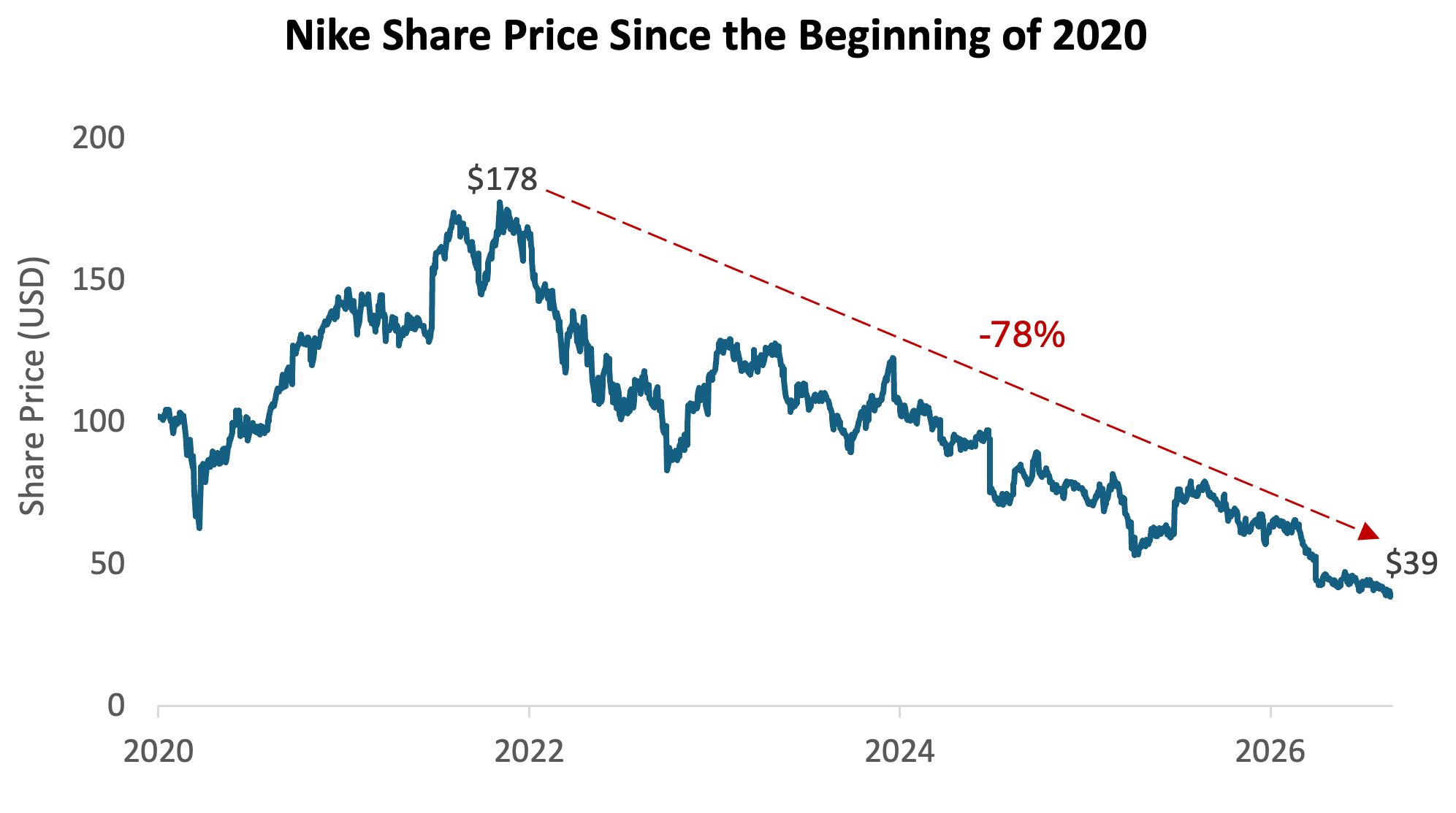
In business, a strong brand can be a powerful competitive advantage. It is a major source of pricing power and, as Warren Buffett famously said, “The single most important decision in evaluating a business is pricing power.” When Nike’s share price peaked at $178 in November 2021, the company appeared to pass this test with ease. Today, it trades at less than $40 per share, 78% below its peak, and is on track for its worst year since Michael Jordan’s retirement in 1993. So, what changed?
Management began treating the strength of the brand like an unlimited resource, rather than something that is continuously earned. As investment and innovation slowed, Nike became increasingly reliant on its biggest franchises, while competitors such as Adidas, On and Hoka offered fresher alternatives. Strategic missteps compounded the problem.
Most notably, Nike pulled back from wholesale partners in favour of its own digital and direct-to-consumer channels, hoping to improve margins and customer relationships. Instead, it weakened retail relationships, reduced its physical presence and proved costly to execute.
The lessons are clear.
Firstly, brand strength and pricing power cannot be sustained by market position alone. Companies must continually invest to improve the value they offer customers. When assessing pricing power, we therefore look beyond current gross margins to consider how a company is investing for the future. A brand must continually earn its premium, or risk creating an opening for competitors.
Secondly, quality is not static. For investors, the important question is not just “How wide is the current moat?” but “Is it getting wider or narrower?”. This is why the assessment of capital allocation and management quality is such an important part of our investment process. Ultimately, when you buy a share, you are buying a management team’s ability to allocate capital and compound value over time.
Nike also illustrates why we have historically avoided the apparel sector. It is crowded and highly competitive; fashion is inherently unpredictable, consumer preferences change quickly and switching costs are low. These characteristics make it difficult to sustain a competitive advantage over the long term.