


18 Nov Enoch’s Regret
Posted at 08:08h
in INSIGHTS
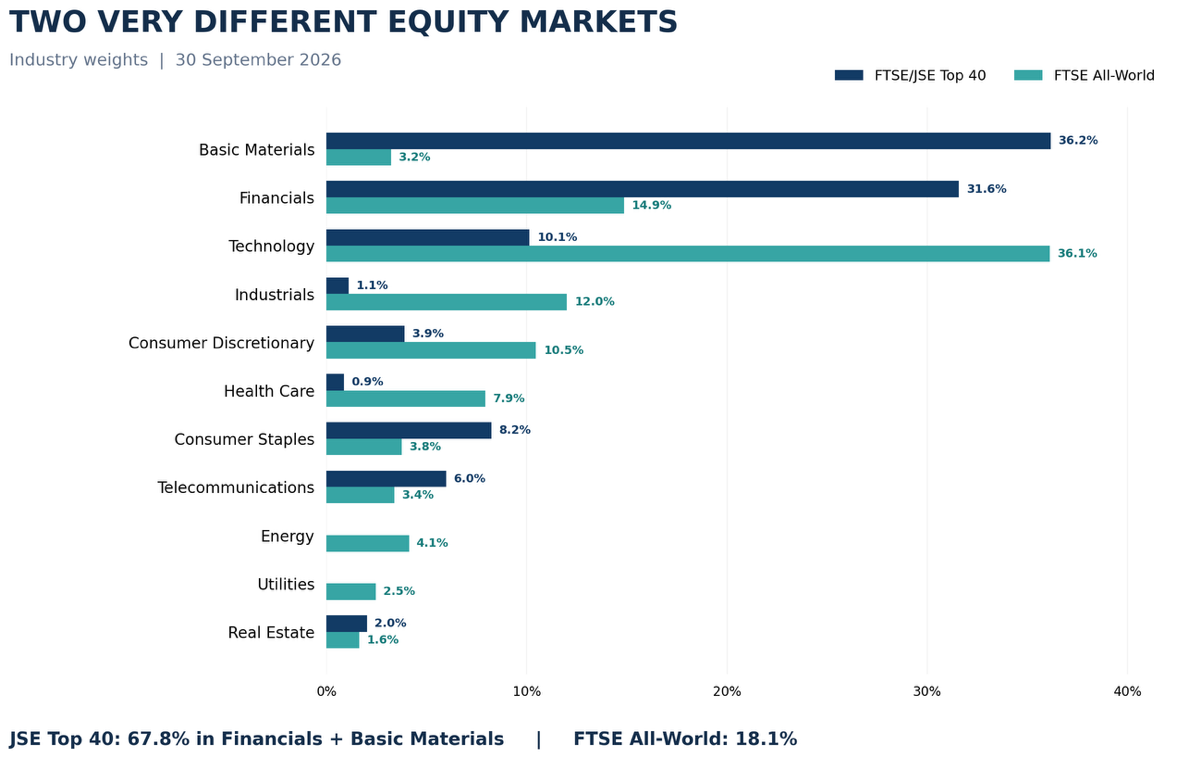
(Source: FTSE Russell factsheets (30 Sep 2026), p. 2. JSE ICB supersectors aggregated to ICB industries.)
Finance Minister Enoch Godongwana has recently expressed regret over his February 2022 decision to increase the offshore investment allowance for South African retirement funds from 30% to 45%. His concerns centre around the diversion of investment capital away from the domestic economy. Regulation 28 of the Pension Funds Act aims to protect retirement savers by promoting diversification and limiting excessive exposure to individual assets and investment categories. Increasing the offshore allowance to 45% provided retirement funds with greater opportunity to access global investment opportunities, reducing their dependence on South Africa’s concentrated market. The debate highlights the challenge of balancing the need to support domestic investment with the responsibility to protect retirement savings.
South Africa only represents 0.4% of the global equity market capitalisation, yet Regulation 28 effectively requires retirement funds to maintain at least 55% of their assets domestically. Furthermore, the local equity market is heavily concentrated. As at September 2026, Basic Materials and Financials accounted for 68% of the JSE Top 40, compared with just 18% of the FTSE All-World Index. Meanwhile, important global industries, including Technology, Industrials and Healthcare, remain significantly underrepresented on the JSE. This concentration leaves local investors disproportionately exposed to commodity cycles, domestic economic conditions and financial sector performance, while limiting participation in industries driving global growth.
For retirement savers, most already have significant exposure to South Africa through their employment, property and other domestic earnings. Further restricting offshore investment would compound this concentration. While reducing the offshore allowance could increase capital available for domestic investment, access to funding is only one part of the equation. South Africa’s investment challenges stem from structural constraints, infrastructure deficiencies and weak economic growth. Directing additional retirement capital domestically does not necessarily resolve these issues and could compromise long-term investment returns.
This is where the High Street Balanced Prescient Fund offers a differentiated approach. As a Regulation 28-compliant fund, it seeks to maximise international diversification within the existing regulatory framework. By fully utilising the offshore allowance and focusing its domestic equity allocation on companies with predominantly international earnings, the Fund aims to minimise dependence on South Africa’s economic fortunes. Importantly, the strategy recognises that a company’s listing location does not necessarily reflect where its earnings originate. Through direct offshore investments and carefully selected rand-hedge JSE-listed companies, the Fund provides 90%+ rand-hedge exposure and broader exposure to international economic activity while remaining Regulation 28 compliant. Ultimately, diversification is not about taking a negative view of South Africa. It is about ensuring retirement savings are not unnecessarily dependent on the fortunes of a single economy.