


18 Nov Old Chips, New Tricks
Posted at 07:56h
in INSIGHTS
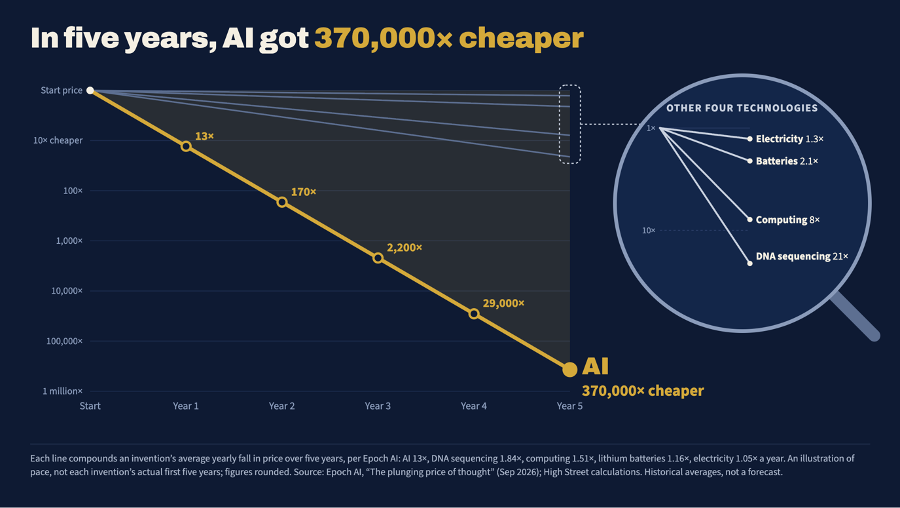
Source: Epoch AI, High Street calculations. Each line compounds an invention’s average yearly fall in price over five years. An illustration of pace, not each invention’s actual first five years, figures rounded. Historical averages, not a forecast.)
Artificial Intelligence (AI) is getting cheaper faster than any transformative technology in history. Epoch AI estimates the cost of a given level of AI performance has fallen 47% a quarter since 2023, roughly 13-fold a year. Yet renting the chips that run AI has become more expensive. If intelligence is getting cheaper, why is the hardware behind it costing more?
AI output is becoming cheaper as models and algorithms improve, requiring less computing power per task. Caching and quantisation techniques let existing chips handle more requests at a lower cost. Smaller, specialised and open-weight models offer cheaper alternatives to large proprietary models, while newer chips deliver more computing power per dollar. As model providers scale, unit costs can fall further, while competition passes some savings on to customers through lower prices.
Source: Epoch AI, High Street calculations. Each line compounds an invention’s average yearly fall in price over five years. An illustration of pace, not each invention’s actual first five years, figures rounded. Historical averages, not a forecast.)
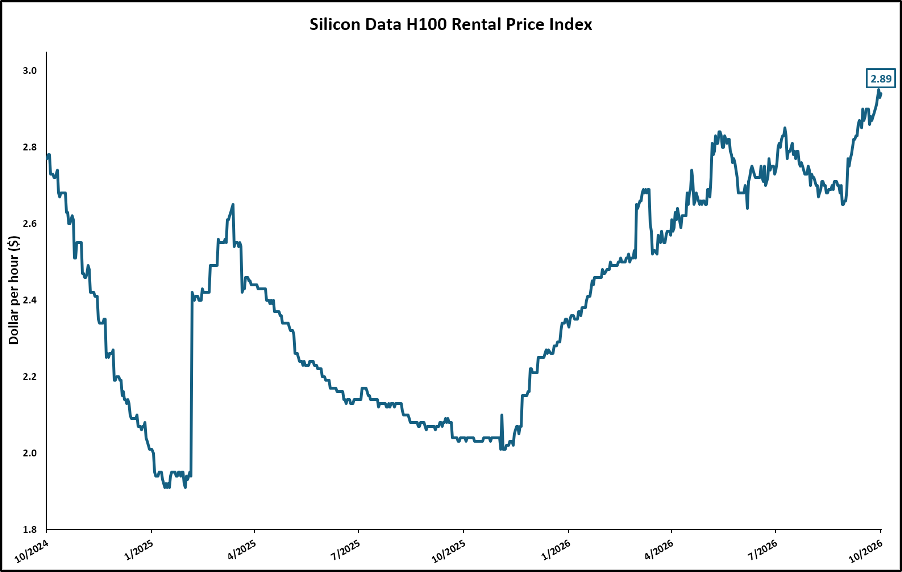
The cost of computing power, however, is moving the other way. The Silicon Data H100 Rental Price Index, which tracks the hourly cost of renting Nvidia’s H100 GPUs, recently reached $2.89, its highest in two years. Older generation H100 chips might be expected to get cheaper as newer chips arrive, but demand for training, inference and increasingly compute-hungry AI agents is outpacing new capacity. New chips take time to become usable: they must be installed in servers, networked and supported by sufficient power and cooling. Meanwhile, hyperscalers and AI developers are locking up capacity for their own workloads, sustaining demand for H100s. This mismatch between demand and newly available capacity is pushing rental prices higher despite advances in chip technology.
The cost of computing power, however, is moving the other way. The Silicon Data H100 Rental Price Index, which tracks the hourly cost of renting Nvidia’s H100 This divergence shows that the AI trade is not a uniform opportunity. Cheaper intelligence helps OpenAI and Anthropic attract customers, but if prices fall faster than usage grows, revenue growth suffers. Providers renting computing power face a further margin squeeze from rising capacity costs.
GPU maker Nvidia, one of High Street’s core holdings, is among the clearest beneficiaries of the AI investment cycle. It combines exposure to a genuine compute bottleneck with a differentiated software ecosystem and an integrated hardware platform. Their hardware serves competing model developers and cloud platforms alike, so it does not depend on any single AI model or application. Technological leadership has turned this demand into rapid revenue growth and persistently high margins.
Being well positioned in AI does not guarantee superior investment returns, valuation and expectations matter too. At High Street, we do not chase short-term AI euphoria. We invest in quality businesses with robust fundamentals at attractive valuations, sizing each holding according to its risk profile.